Affiliate disclosure: This article contains an affiliate link. If you buy through it, we may earn a commission at no extra cost to you. It never changes what we recommend.
You need a voiceover. You do not have a microphone, you do not want to record yourself, and you definitely do not want another monthly subscription. That is the exact problem this review starts from — and it is the problem VocalLab is built to solve.
In the video walkthrough on this channel, VocalLab turns a written script into a natural-sounding voice, clones a real voice from a short sample, and exports audio you can drop straight into an edit. The question is whether it is actually good enough to replace ElevenLabs — the tool everyone measures voice AI against — or whether it is just cheaper.
Short answer: for creators who publish voiceovers every week, VocalLab is the most convincing ElevenLabs alternative we have looked at. It is not better than ElevenLabs at raw voice quality. It is better at the maths: a real free trial, honest monthly pricing, and — until it sold out — a one-time lifetime deal. Here is the full picture, including the catch.
Browse more in our AI Voice Tools guides, including the best AI tools for small business and the best AI tools for students.
VocalLab at a glance
| VocalLab | |
|---|---|
| What it is | Browser-based AI voice studio: text-to-speech, voice cloning, voice design, captions |
| Voices | 260+ ready-made voices, 200+ languages |
| Voice cloning | Yes — from about 30 seconds of audio |
| Voice design | Yes — describe a voice in plain English, get a new one |
| Captions | Word-level SRT export with every generation |
| Free trial | 60 points (about 1 minute of audio), 1 voice clone, no card required |
| Paid plans | Lite $9/mo, Pro $24/mo, Max $299/mo |
| AppSumo lifetime deal | Sold out (verified 2026-11-16) — was $49–$1,500 one-time |
| AppSumo rating | 4.7 out of 5 |
| Best for | YouTubers, faceless channels, podcasters, audiobook creators |
| Not for | Anyone who needs the absolute best cloning quality money can buy, or enterprise voice agents |
How we tested VocalLab
Three sources, no shortcuts:
- The video walkthrough. The full workflow was tested on camera: text-to-speech, voice cloning, voice design, and the finished voice placed into a real video edit — with an honest verdict at the end. The chapters tell the story: hear the voice first, then the walkthrough, then the real edit, then the honest answer.
- The live product pages. VocalLab’s own homepage and pricing page, checked on 2026-11-16, for the current plans, limits and features.
- The AppSumo listing. The deal page, reviews and tier table, checked live on 2026-11-16 — which is how we caught that the lifetime deal has sold out.
We did not run a blind listening test of VocalLab against ElevenLabs on the same script, and this review does not claim one. Where a comparison rests on published specs and other reviewers’ tests rather than our own, we say so.
What is VocalLab?
VocalLab is a browser-based AI voice studio from a small team in Tel Aviv, Israel, founded in November 2025 by Petr Sibirtsev. It turns written scripts into natural-sounding voiceovers, and it is aimed squarely at creators — YouTube videos and Shorts, TikTok and Reels, podcasts, audiobooks, ads, product demos and courses — rather than at enterprise call centres.
That youth is worth stating plainly. This is a young, bootstrapped startup, not a company with years of track record. What it has instead is a founder shipping weekly updates in direct response to user feedback on AppSumo — video dubbing, speech-to-text, an ebook-to-audiobook workspace and cloning improvements have all landed since the deal launched in July 2026. For a tool you would build a workflow around, that shipping speed matters as much as the feature list.
What VocalLab actually does
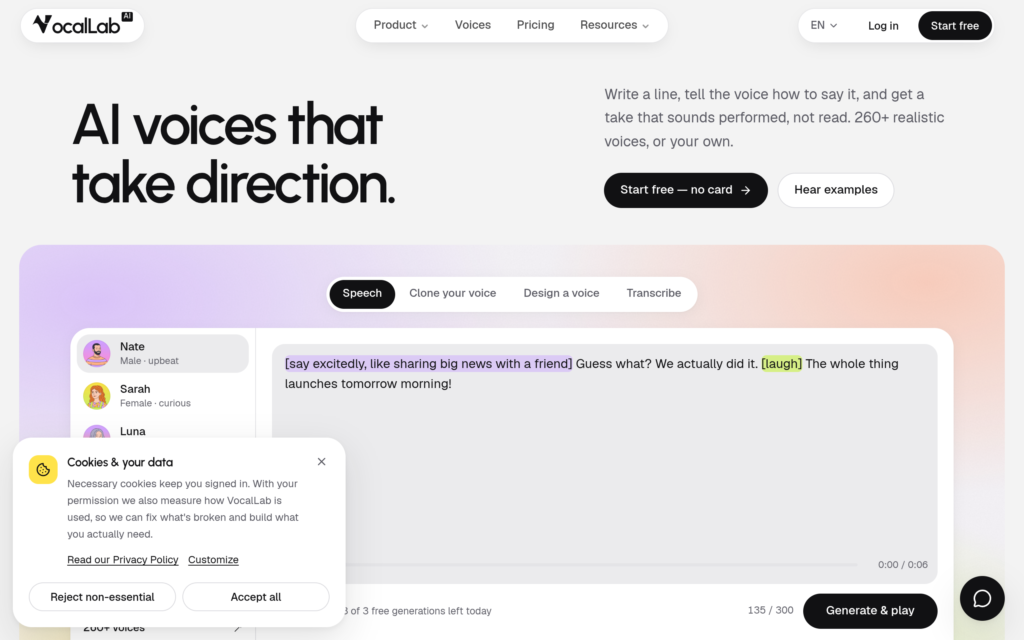
Text-to-speech that sounds performed, not read
Paste a script, pick a voice, generate an MP3. The entry tier handles up to 10,000 characters in one generation; higher tiers go up to 40,000, so a long script does not need to be stitched together from fragments. The difference from flat, robotic TTS is the delivery controls: you can direct each line in plain English using bracketed instructions, and add breaths, laughs, sighs and throat clears as inline tags. Eight selectable emotions set the tone of a scene. For narration-heavy content — storytelling channels, audiobooks, character voices — those controls matter more than raw voice quality, because monotone delivery is what makes AI narration feel obviously synthetic.
260+ voices in 200+ languages
The voice library holds more than 260 ready-made voices, filterable by accent, age, gender and style, across 200+ languages. The spread goes beyond the standard American and British defaults most TTS tools lead with — though independent reviewers note that quality outside English is uneven, and the expanded language support beyond the core languages is labelled an experimental preview. If your audience is non-English, test your language on the free trial before paying anything.
Voice cloning from 30 seconds
Upload about 30 seconds of clean speech and VocalLab builds a clone you can use for any text. In the video walkthrough, cloning is shown end to end, and the AppSumo reviews include buyers saying friends could not tell the clone from the real voice. One reviewer used about two-thirds of a tier’s monthly points narrating a two-hour audiobook. Two honest caveats from other reviewers: cloning quality has needed rework since launch, with a July 2026 update specifically improving accuracy from the same short sample — and one 1-star review reports a clone that sounded like someone else. Cloning is a strength here, not a guarantee. Test it with your own voice first.
Voice design: describe a voice, get a voice
Instead of cloning a real person, describe the voice you want — accent, age, gender, tone — and VocalLab generates a new one. A recent update added an “Improve” button that rewrites a rough description (“calm British woman for sleep stories”) into a detailed prompt the model follows more reliably. This is the feature for character voices and faceless channels that need a consistent narrator who is nobody in particular.
Word-level SRT captions, built in
Every generation can be exported as MP3, and VocalLab also produces word-level SRT captions with karaoke-style highlighting — the word-by-word emphasis that Shorts, Reels and TikTok now expect. Higher tiers add WAV download, which matters if you process audio further in a DAW instead of dropping it straight into a video editor. The captions export is also available through the API and MCP server, so it can feed an automated pipeline.
Audiobooks workspace (beta)
The chapter-based Audiobooks workspace converts an ebook (EPUB, PDF, DOCX or TXT) into an audiobook: it detects the narrator and each speaking character, lets you cast a voice to each one, and exports the finished audio as a single file. You can close the tab and get emailed when it is ready. It is still labelled beta, and it has seen the most active development of any VocalLab feature — which is both encouraging and a reminder that it is the least settled part of the product.
Video dubbing and speech-to-text
Video dubbing arrived in August 2026 and is in beta: upload a video, pick a language, get it back re-voiced with the timing preserved, plus an SRT track. Dubbing covers 15 languages, including Hindi. Speech-to-text went live in July 2026 across 25+ auto-detected languages, at roughly 15 points per minute — about four times cheaper than generating speech. Both are useful, both are young.
API and MCP access
Developers get API and MCP access on every paid plan, starting with Lite at $9 a month — anything the Studio can do, from code or straight from an AI assistant. It is a genuinely strong inclusion: you can script voiceovers, captions and cloning into a pipeline and drive it from Claude or any other MCP client. Note the gate, though: API access is not included on the free plan. If developer integration is why you are buying, the $9 Lite plan is the entry point.
VocalLab pricing: what it actually costs
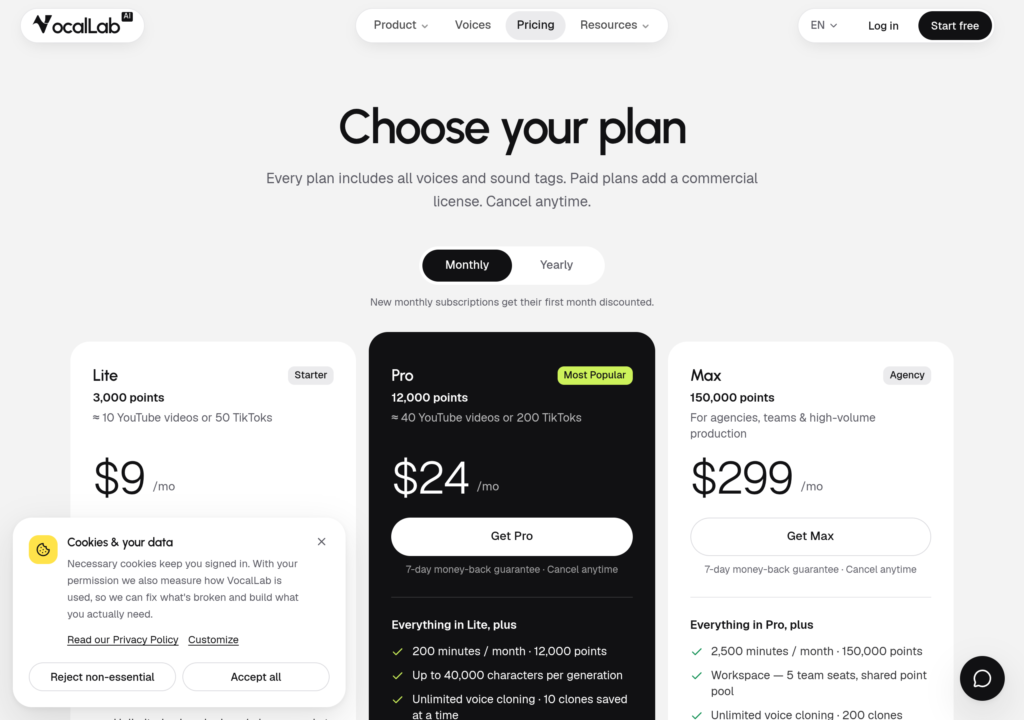
VocalLab’s own subscription pricing, checked on 2026-11-16:
| Plan | Price | What you get |
|---|---|---|
| Free | $0 | 60 points (about 1 minute of audio), every voice, 1 voice clone (one-time), personal use only |
| Lite | $9/month | 3,000 points (about 50 minutes), up to 10,000 characters per generation, 1 saved clone, MP3 download, commercial-use licence, audiobook editor |
| Pro | $24/month | 12,000 points (about 200 minutes), 40,000 characters per generation, 10 saved clones + 5 designs, WAV + MP3, priority queue, API & MCP access, 90-day history |
| Max | $299/month | 150,000 points (about 2,500 minutes), 5 team seats with a shared pool, 200 saved clones, highest API limits, 1-year history |
Yearly billing drops the prices to $7.50, $20 and $249 a month. Points work out at roughly 17 characters per point, or about 1 point per second of audio. At 60 points, the free trial gives you roughly a minute — enough to judge the voices, not enough to make a video with.
The AppSumo lifetime deal: sold out
This is the part that changed since we planned this review. VocalLab’s AppSumo lifetime deal — six tiers from $49 to $1,500 one-time, including a $1,500 Tier 6 for AppSumo Plus members — is sold out as of 2026-11-16. We verified this live on the AppSumo deal page today: its listing now shows “Sold out!”, and independent reviewers updated in the last few days confirm the same.
What the deal was, for reference: Tier 1 ($49) gave 50 minutes a month and 1 voice clone; Tier 2 ($139) gave 150 minutes and 10 clones; Tier 3 ($299) gave 400 minutes, 100 clones, API access and MCP; Tier 4 ($699) gave 1,000 minutes, 200 clones, three shared seats and the highest API limits. Tier 5 gave 1,500 minutes and 300 clones; Tier 6 ($1,500, AppSumo Plus only) gave 2,250 minutes, 300 clones and five shared seats.
If you missed it, the deal page still has a “notify me when it returns” option, and AppSumo deals do sometimes return. The button below goes to the deal page through our affiliate link — check it before assuming anything about availability.
The honest maths, with the deal gone: Lite at $9 a month is $108 a year for 50 minutes a month. The old Tier 1 was $49 once for the same allowance. That is why the deal mattered — and why, without it, VocalLab has to win on the product itself, not the price. It mostly does.
VocalLab vs ElevenLabs: the comparison that matters
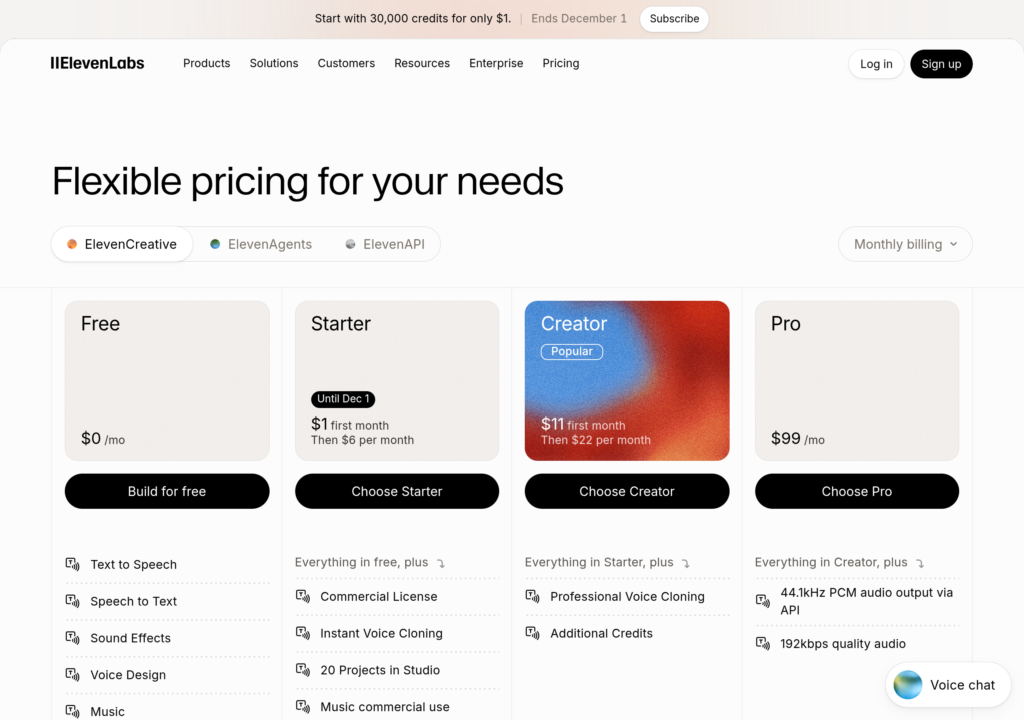
ElevenLabs is the benchmark. It has the most expressive voices and the most mature toolset, and its Creator plan at $22 a month is what most YouTubers land on. Here is how the two line up on the numbers that decide a purchase:
| VocalLab | ElevenLabs | |
|---|---|---|
| Free tier | 60 points (~1 minute), 1 clone, personal use | 10,000 characters/month (~10 minutes), no commercial licence |
| Cheapest paid plan | Lite $9/mo — 50 minutes, 1 clone, commercial licence | Starter $6/mo — 30,000 characters, commercial rights |
| Mid plan | Pro $24/mo — 200 minutes, 10 clones, API & MCP | Creator $22/mo — ~100,000+ characters, professional voice cloning |
| Voice cloning | From ~30 seconds, from the $9 plan | Instant cloning from Starter; professional cloning from Creator |
| Voices / languages | 260+ voices, 200+ languages | 5,000+ voices, 74 languages |
| Captions | Word-level SRT export built in | Via separate tools/workflows |
| Audiobooks | Dedicated workspace with ebook import | No dedicated audiobook workspace |
| Video dubbing | Built in (beta), 15 languages | Via separate dubbing product |
| Lifetime deal | Sold out (was $49 one-time) | None — subscription only |
| Best for | Regular voiceover volume, captions, audiobooks | Best raw voice quality, biggest voice library, voice agents |
Two things to take from that table. First, ElevenLabs still wins on raw quality and library size — no independent blind test we found puts VocalLab ahead of ElevenLabs on voice quality alone, and this review does not claim otherwise. Second, VocalLab wins on everything around the voice: captions in the same workflow, an audiobook workspace, dubbing, and a much lower cost per minute at the entry level. At $9 a month for 50 minutes with a commercial licence and a clone included, VocalLab’s Lite plan undercuts ElevenLabs’ Creator plan for a creator whose main need is narration, not the last 5% of realism.
Other ElevenLabs alternatives, briefly
- Murf — better for narrated training videos and slides, with the cheapest API in the category (about $10 per million characters). Creator from $19 a month billed yearly; voice cloning is an enterprise add-on.
- Speechify — best for turning documents into audio to listen to, not for cinematic narration. Premium $29 a month or $139 a year, 1,000+ voices.
- Cartesia — best for real-time voice agents, with sub-90ms first-audio claims. Pro from $5 a month with commercial licence and instant cloning.
- Fish Audio — the closest all-round swap on quality per dollar, with S2 Pro beating ElevenLabs V3 in blind A/B testing about 60% to 40% across 71,000+ comparisons. Plus from $15 a month.
None of those offers a lifetime deal either. VocalLab’s one-time-purchase window is what set it apart — and it is closed for now.
VocalLab pros and cons
Pros
- Large, varied voice library — 260+ voices across accents and styles.
- Voice cloning and voice design both included — two different paths to a custom voice.
- Expressive delivery controls — emotions, breaths, laughs and sighs that fight the robotic-TTS problem.
- MP3 and word-level SRT export in one workflow — built for caption-heavy short-form video.
- Dedicated audiobook workspace with ebook import — a real workflow, not a checkbox.
- API and MCP access on every paid plan — the same tools, available to automation.
- Commercial use included even on the entry-level paid plan.
- Founder shipping weekly updates in direct response to user feedback.
- A genuine free trial with no card required — 60 points and a clone to test with.
Cons
- Monthly usage limits apply even on lifetime tiers — heavy users hit ceilings, and unused points do not roll over.
- API and MCP access are paid-only — not included on the free plan.
- Voice cloning quality has needed rework since launch — results vary by sample and language.
- Non-English quality is uneven; expanded languages are an experimental preview.
- The audiobook workspace is still in beta.
- Founded November 2025 — a short track record next to established competitors.
- The AppSumo lifetime deal has sold out — the price advantage that defined it is gone for now.
- Occasional server connection complaints in AppSumo reviews, and a reported regeneration bug the team says it is working on.
Who should use VocalLab?
- YouTubers and faceless-channel creators who need regular narration without recording themselves.
- Short-form creators on TikTok, Reels and Shorts who want karaoke-style captions in the same workflow.
- Podcasters who want a consistent host voice for intros, transitions and character segments.
- Audiobook creators exploring AI narration, especially with the ebook-to-audiobook import.
- Marketers and educators producing explainer or training content that would get expensive with a voice actor per project.
- Freelancers and agencies who would rather pay once than add another subscription — if the lifetime deal returns.
Who should NOT use VocalLab?
- Anyone who needs the absolute best cloning quality available — ElevenLabs is still the benchmark, and its professional cloning is the safer bet for a flagship brand voice.
- High-volume producers who need far more than 1,000 minutes a month — the monthly caps are real, and no lifetime tier removes them.
- Teams needing real-time voice agents — Cartesia is built for that; VocalLab is built for narration.
- Anyone buying only because of the lifetime deal — it has sold out. Buy VocalLab for the subscription product, or wait and watch the deal page.
Frequently asked questions
Is VocalLab a good ElevenLabs alternative?
For narration — YouTube voiceovers, podcasts, audiobooks — yes. It is cheaper per minute, includes captions and an audiobook workspace, and its cloning is convincing for most creator use. For the absolute best raw voice quality or real-time voice agents, ElevenLabs is still ahead.
Is the VocalLab lifetime deal still available?
No. The AppSumo lifetime deal sold out, verified on 2026-11-16. The deal page offers a notify-me option if it returns. VocalLab’s subscription plans — Free, Lite $9/month, Pro $24/month, Max $299/month — are still available on vocallab.ai.
How much does VocalLab cost?
The free plan gives 60 points (about a minute of audio) with no card required. Paid plans are Lite $9 a month (about 50 minutes), Pro $24 a month (about 200 minutes), and Max $299 a month (about 2,500 minutes, for teams). API and MCP access is included on every paid plan. Yearly billing is cheaper: $7.50, $20 and $249 a month.
Can VocalLab clone my voice?
Yes. Upload about 30 seconds of clean speech and VocalLab builds a clone you can use for any text. Cloning is included from the Lite plan, and the free trial includes one clone. Quality varies by sample and language, so test it with your own voice before committing.
Does VocalLab include commercial rights?
Yes. Every paid plan includes a full commercial licence — ads, monetised YouTube videos, TikTok, podcasts and client work, without attribution. The free plan is personal use only.
Does VocalLab export captions?
Yes. Every generation can be exported as MP3 with a word-level SRT caption file, timed to every word, ready for CapCut, Premiere or Final Cut. Higher tiers add WAV download.
How many languages does VocalLab support?
VocalLab lists 200+ languages, with 260+ voices. English quality is the strongest; quality in other languages is uneven, and languages beyond the core set are an experimental preview. Test your language on the free trial first.
The verdict
VocalLab is the ElevenLabs alternative for creators who publish voiceovers every week and are tired of paying per month for the privilege. Its voices sound human, its cloning is convincing enough that buyers’ friends could not tell the difference, and the workflow — script, voice, captions, export — is built for people who make videos, not for people who demo software.
The catch is real and it is dated today: the lifetime deal that made VocalLab a no-brainer has sold out. Without it, VocalLab has to win on the product, and it mostly does — at $9 a month for 50 minutes with a clone and a commercial licence, it is still the cheapest serious narration tool we have reviewed. But if the deal returns, that is the moment to buy. Join the notify list on the deal page and check back.
Our recommendation: start with the free 60 points. Generate your actual script, clone your actual voice, drop it into your actual edit. If it sounds right in your video, the Lite plan is the cheapest honest way to keep it sounding right every week.
Last updated: 16 November 2026. Prices and deal availability were checked live on 2026-11-16 and change quickly — check the live listing before you buy.